dunsborough and south west wa
Verti-Mowing & Scarifying
Remove thatch, reduce sponginess and rejuvenate your lawn.
VERTI-MOWING & SCARIFYING
THE DEEP CLEAN YOUR LAWN NEEDS
Does your lawn feel spongy to walk on? Does the mower sink into it, leaving circle marks or scalped patches? Is it turning brown or grey even when you water it? If so, you likely have a thatch problem. Thatch is the hidden enemy of mature lawns in the South West. It slowly chokes the turf, prevents water penetration, and harbours disease.
The Master Grass provides professional verti-mowing (also known as scarifying or dethatching) services in Dunsborough. This is not a standard maintenance service; it is a major renovation procedure. It is the only way to physically remove the built-up layer of dead organic matter and reset the height of your lawn. While the process looks aggressive, it is essential for the long-term health and performance of varieties like Couch and Kikuyu.
WHAT IS THATCH & why is it bad?
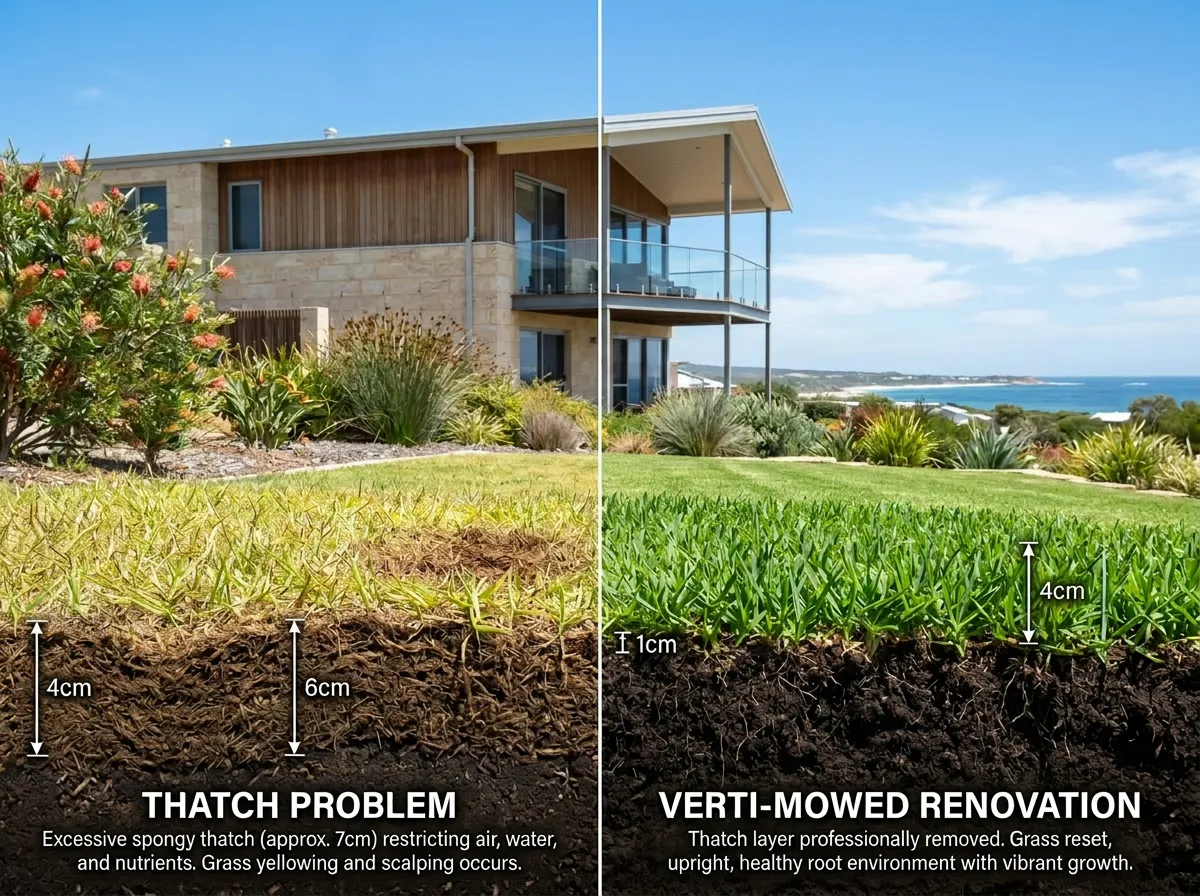
Thatch is a layer of living and dead organic debris — roots, rhizomes, stolons, and leaf sheaths — that accumulates between the green grass blades and the soil surface.
In a healthy lawn, soil microbes break this down as fast as it is produced. However, with our vigorous warm-season grasses (especially Kikuyu) and high fertiliser use, the lawn often produces organic matter faster than it can decompose.
The "Spongy" Effect
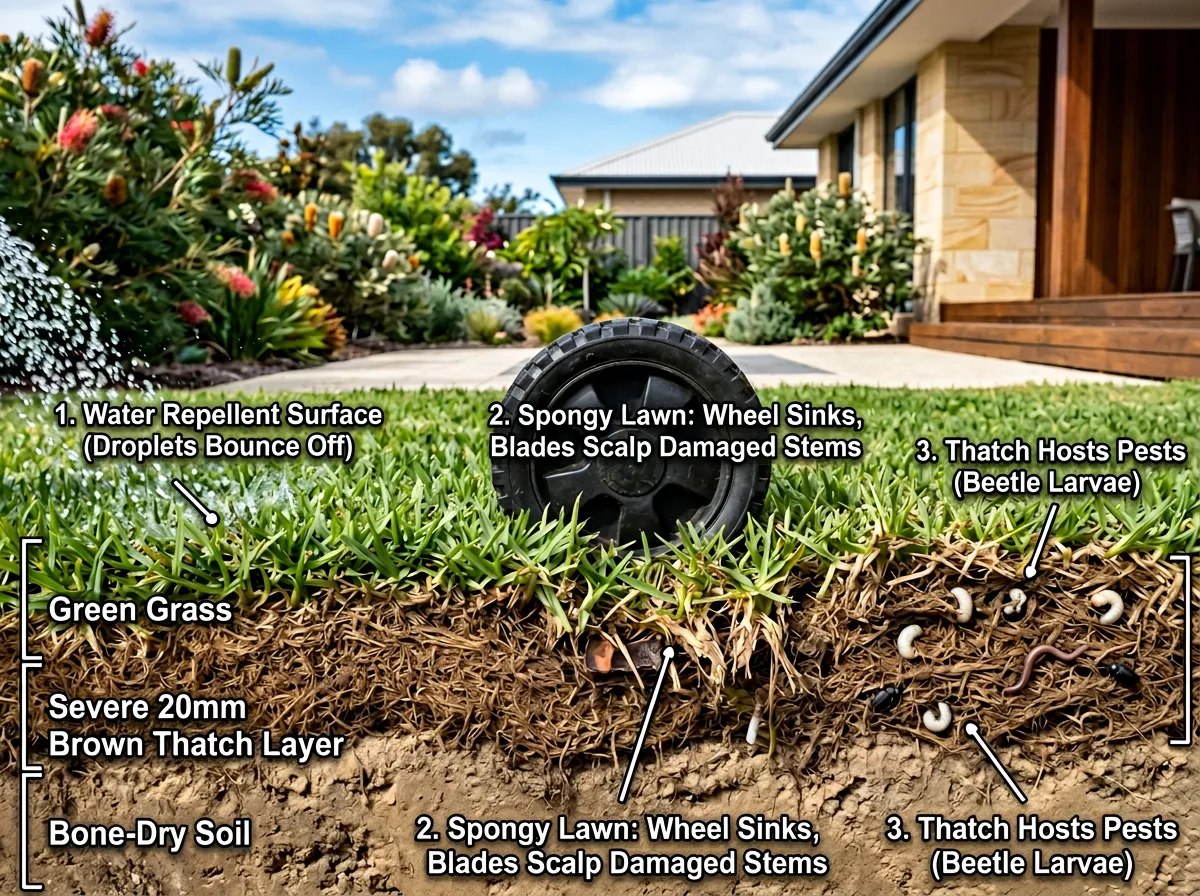
When the thatch layer gets thick (over 15mm), the lawn starts to grow on top of the thatch rather than in the soil. The roots are shallow and sitting in dry, dead material.
Water Repellency: Thatch acts like a thatched roof. Water runs off it rather than soaking through. You might water for 20 minutes, but the soil below is bone dry.
Mower Scalping: Because the lawn is "puffy," the mower wheels sink in. You end up cutting the grass too low, exposing the brown stems. This gives the lawn a patchy, bruised look.
Disease and Pests: Thatch is a breeding ground for fungal diseases and pests like Armyworm and Black Beetle larvae.
VERTI-MOWING VS REGULAR MOWING
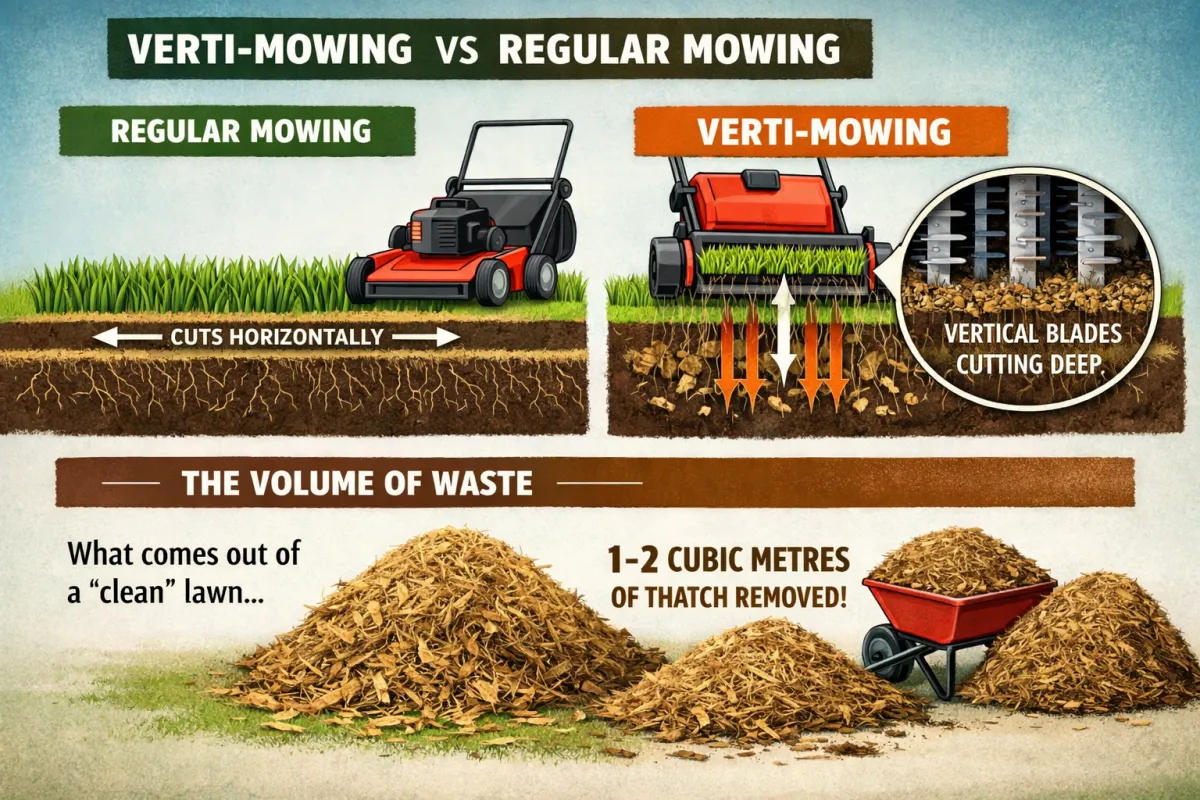
A regular mower cuts the grass horizontally. A verti-mower cuts vertically.
We use specialised machines equipped with vertical steel blades or knives. These blades spin at high speed and slice deep into the turf canopy, cutting through the stolons and ripping out the accumulated debris.
The Volume of Waste
The amount of material that comes out of a "clean" looking lawn is shocking. On a standard 50sqm backyard, we might pull out 1-2 cubic metres of thatch. It looks like heaps of brown straw.
THE PROCESS - WHAT TO EXPECT
Verti-mowing is renovation surgery. It gets worse before it gets better.
1. Scalping
We start by mowing the lawn as low as possible with a rotary mower to remove the green leaf bulk.
2. The Verti-Mow Passes
We run the verti-mower over the lawn. We usually do multiple passes in different directions (e.g., North-South, then East-West) to ensure we get all the thatch. The machine rips up the dead material and thins out the runners.
3. Clean Up
We rake, blow, and vacuum up the debris. We remove all the waste from your property (which is a significant job in itself).
4. The Aftermath
Your lawn will look terrible. It will be brown, thin, and stubbly. You will see soil. Do not panic. This is exactly what is needed. We have removed the "choke" hold.
5. Recovery
We apply a high-quality wetting agent and a fertiliser to kick-start growth. You must keep the water up to it. Within 10-14 days, you will see fresh green shoots. Within 3-4 weeks, you will have a brand new lawn that is tight, green, and firm.

WHICH GRASSES NEED VERTI-MOWING
Couch & Kikuyu
These varieties grow via underground runners (rhizomes) and above-ground runners (stolons). They are incredibly tough. They love verti-mowing. You can be very aggressive with them, and they bounce back thicker than ever. They typically need verti-mowing every 1-2 years.
Buffalo (e.g. Sir Walter)
Buffalo only grows from above-ground stolons. If you verti-mow Buffalo too hard and remove all the runners, it cannot recover (it has no underground reserve). We use a much gentler setting for Buffalo, often referred to as "grooming," to thin the canopy without killing the lawn.
TIMING IS EVERYTHING
Because verti-mowing relies on rapid regrowth, we only do it during the growing season.
Best Window:
Spring (September – November) and Early Autumn (March).
Do Not Do It:
In Winter (the lawn will sit brown for months) or during a heatwave (too much stress).
OTHER SERVICES
Fertilising
Program

Paving
Installation

Top
Dressiing

Lawn
Mowing
FAQ'S
Will verti-mowing kill weeds?
It won’t kill deep-rooted weeds, but it removes a lot of surface weed mass. More importantly, the new dense grass growth will outcompete weeds.
My lawn is bumpy, will this flatten it?
It helps reduce the "puffy" bumps caused by thatch. However, if the ground soil itself is uneven, you need top dressing (which we often do straight after verti-mowing).
Do I need to top dress after?
It is highly recommended. The verti-mowing opens the sward; top dressing fills the gaps and levels the surface. The two services go hand-in-hand.

Areas We Serve
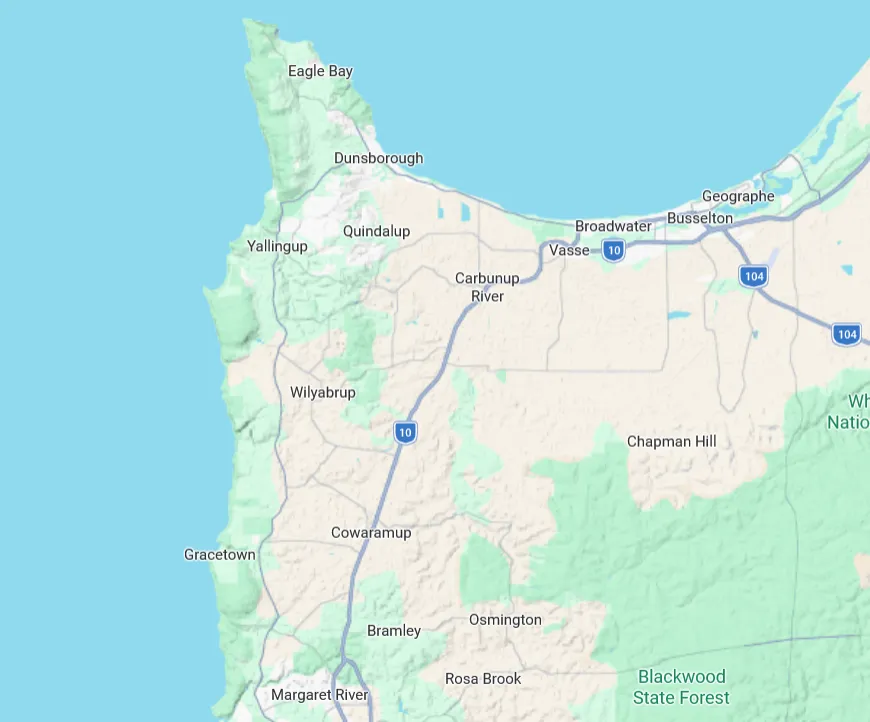
We operate from Dunsborough and work across the South West—Busselton through to Margaret River, including Yallingup and Cowaramup. If you're outside that core (Dunsborough East, Siesta Park, Metricup), send your location and we'll check the drive.
Service Areas
Dunsborough
Busselton
Margaret River
Yallingup
Cowaramup
Ready To REJUVENATE YOUR LAWN?


LANDSCAPING
SERVICES
MAINTENANCE
COMPANY
© Copyright 2026. The Master Grass. All Rights Reserved.